

Introduction: Why Field Technicians Need Better Tools
Field service teams often begin their day with a long list of tasks, multiple calls from dispatch, and customers waiting for updates. In many organizations, technicians still rely on printed work orders, phone calls, or information scattered across several systems. This approach creates delays and unnecessary frustration.
Imagine arriving at a customer site only to realize that the equipment details or service history are missing. A simple repair suddenly requires calls to the office, waiting for records, and confirming information that should already be available.
This is exactly where a mobile field service app becomes valuable.
Modern service platforms such as the solution provided by Invoqat enable organizations to coordinate field operations through mobile technology. Instead of depending on paperwork and manual communication, technicians receive job assignments, equipment details, and updates directly on their devices.
The result is straightforward:
- Technicians work more efficiently
- Managers receive real-time updates
- Customers experience faster and more reliable service
Before examining the benefits in detail, it helps to compare traditional service operations with mobile-enabled systems.
Traditional Service Work vs Mobile Field Service
| Service Activity | Traditional Approach | Mobile-Based Approach |
|---|---|---|
| Job assignment | Printed schedules or phone calls | Digital work orders |
| Job updates | End-of-day reporting | Real-time progress updates |
| Customer details | Stored at office systems | Accessible through mobile devices |
| Communication | Frequent phone calls | In-app updates |
| Documentation | Paper forms | Digital reports |
While the contrast seems clear, the real impact appears in the everyday experience of technicians.
The Everyday Friction Technicians Experience
When technicians describe the most frustrating aspects of their work, the problem rarely involves repairing equipment.
Instead, common complaints include:
- Missing job information
- Unclear service instructions
- Repeated phone calls to confirm details
- Paperwork at the end of the day
These small interruptions gradually accumulate.
For example, a technician might arrive at a location only to discover that the equipment model number is missing. The office must search for the information, which delays the repair process.
A technician mobile app reduces these disruptions because the necessary information travels with the technician.
Why Mobile Field Service Tools Matter Today
Service operations have changed significantly over the past decade.
Service teams now:
- Cover larger geographic areas
- Maintain more complex equipment
- Respond to customers who expect faster service
Because of these changes, field service mobile software has become essential across industries.
Organizations in utilities, maintenance services, telecommunications, and equipment repair increasingly rely on mobile workforce tools to coordinate technicians.
Companies in the UAE have also begun adopting mobile field service platforms as service operations expand and manual coordination becomes less practical.
The key shift is not just technological it is operational.
Real-Time Work Orders Improve Daily Operations
A mobile field service app places technicians directly within the information flow.
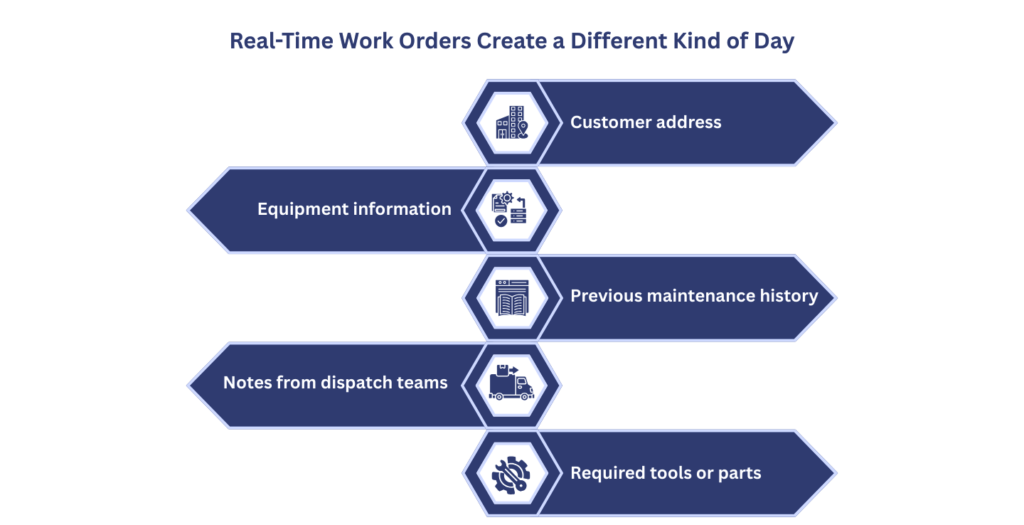
Instead of waiting for instructions from dispatch, technicians can immediately view their assigned work orders. These typically include:
- Customer location details
- Equipment specifications
- Maintenance history
- Dispatch notes
- Required tools or spare parts
This preparation makes a significant difference.
Technicians arrive at service locations better informed and ready to begin repairs immediately.
Communication Becomes Simpler
Field service teams traditionally rely heavily on phone communication. Technicians call dispatch for updates, dispatch contacts technicians for progress reports, and customers may call both.
Over time, communication becomes disorganized.
A mobile workforce management system introduces structure.
Technicians update job status through the mobile application. Dispatch teams monitor progress without interrupting repairs. Managers track job completion and scheduling through dashboards.
As a result, something interesting happens:
The number of phone calls decreases dramatically.
Productivity Improvements from Mobile Service Tools
| Productivity Area | Result |
|---|---|
| Job preparation | Faster technician readiness |
| Service history access | Improved troubleshooting |
| GPS navigation | Reduced travel delays |
| Digital reporting | Less administrative work |
| Live job updates | Better coordination |
Individually, these improvements may seem small. Collectively, they transform the technician’s daily workflow.
Paperwork Begins to Disappear
Paper documentation remains one of the least popular parts of field service work.
After completing several jobs, technicians often need to:
- Fill out service forms
- Upload job photos
- Collect customer signatures
- Prepare reports for the office
Traditionally, this work waits until technicians return to the office.
With field service mobile software, technicians complete these tasks directly after finishing a job. Reports are submitted immediately through the mobile device, and office teams receive the information instantly.
This eliminates the backlog of paperwork at the end of the day.
Travel Time: The Hidden Productivity Challenge
Technicians often spend a large portion of their day traveling between service locations.
Inefficient scheduling, unclear routes, and traffic delays reduce the number of jobs technicians can complete.
A mobile workforce management platform helps optimize travel through:
- GPS navigation
- Smart route planning
- Location-based scheduling
Even small improvements saving 15 or 20 minutes between jobs can significantly increase daily productivity.
Knowledge in the Technician’s Pocket
Field service technicians frequently need access to technical resources while on site.
These may include:
- Equipment manuals
- Diagnostic procedures
- Previous service reports
- Maintenance guidelines
A technician mobile app allows technicians to access this information instantly.
Instead of relying on memory or contacting the office, technicians can consult the necessary documentation directly from their device.
This leads to faster and more accurate repairs.
Improving the Customer Experience
Customers may not think about field service technology, but they quickly notice when service runs smoothly.
When technicians use mobile service tools, customers typically experience:
- Faster arrival times
- Better-informed technicians
- Clear service documentation
- Improved follow-up communication
Customers value transparency and professionalism. When technicians arrive prepared, trust naturally increases.
Growing Industry Adoption of Mobile Workforce Tools
Service industries worldwide are increasingly adopting mobile workforce technology.
Industry analysts often point out that distributed workforces and remote operations require constant access to information. Mobile systems allow technicians to remain connected regardless of location.
As a result, sectors such as utilities, telecommunications, equipment maintenance, and infrastructure services are rapidly adopting mobile field service platforms.
The direction is clear: field service operations are becoming more connected and data-driven.
Core Features of Mobile Field Service Platforms
| Feature | Purpose |
|---|---|
| Job scheduling | Organizes technician assignments |
| Mobile work orders | Delivers job details instantly |
| Technician tracking | Monitors service activity |
| Digital reporting | Records completed work |
| Performance analytics | Evaluates service efficiency |
These features are most effective when integrated within a single system.
How Invoqat Field Service Supports Field Teams
The Invoqat Field Service solution focuses on simplifying coordination between technicians and office teams.
Instead of relying on separate tools, organizations can manage:
- Scheduling
- Job assignments
- Service documentation
- Technician activity
within a unified platform.
This structure enables organizations to:
- Monitor technician progress easily
- Improve communication between teams
- Maintain accurate service records
- Coordinate field operations more efficiently
Rather than complicating workflows, the system organizes the information technicians already rely on.
Conclusion: Technology That Helps Technicians Work Better
Field technicians play a critical role in maintaining infrastructure, repairing equipment, and delivering essential services.
Despite this responsibility, many technicians still work with outdated systems that slow them down.
A mobile field service app introduces a simple but powerful improvement: it delivers the right information at the right time.
Work orders arrive instantly. Service records remain accessible. Reports are sent to the office immediately after completion.
Solutions such as the Invoqat Field Service platform demonstrate how technology can support technicians without adding unnecessary complexity.
Ultimately, the goal is not to change the work technicians perform.
The goal is to remove the obstacles that prevent them from doing their best work.
Frequently Asked Questions
A mobile field service app allows technicians to receive job assignments, access equipment details, update job status, and submit service reports using a mobile device.
It reduces paperwork, improves communication with dispatch teams, and provides technicians with real-time access to service information.
Industries such as utilities, telecommunications, equipment repair, maintenance services, and logistics commonly use mobile field service applications.
Yes. Even small service teams often improve scheduling, communication, and reporting efficiency after adopting mobile service tools.
Invoqat provides a field service platform that helps organizations manage technician scheduling, digital work orders, service reporting, and real-time operational visibility.
