
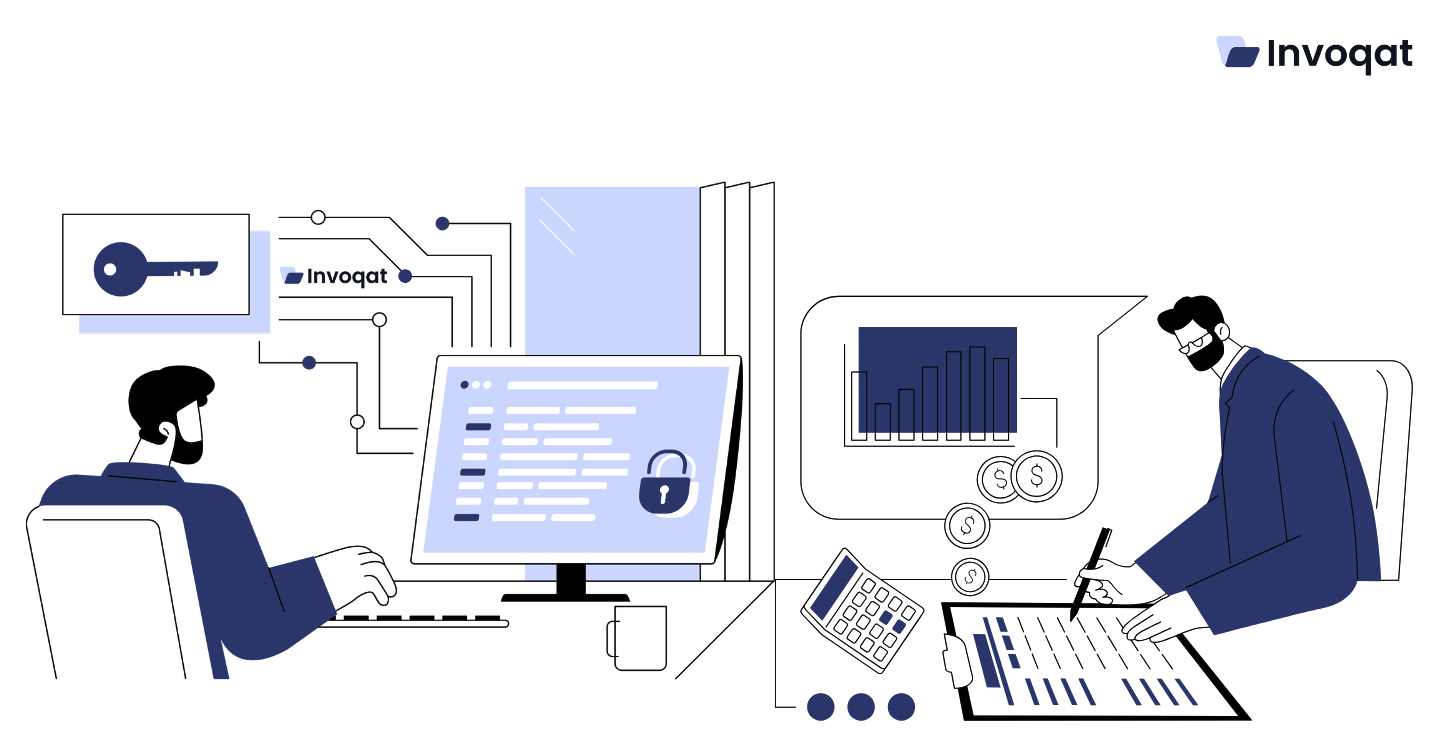
Financial data has become one of the most valuable assets within modern businesses. Invoices contain information about suppliers, customers, payments, tax records, contracts, and financial transactions. Therefore, protecting this information is essential for maintaining business continuity and trust.
Imagine arriving at work and discovering that important invoice records are missing. Payment approvals cannot be located, suppliers are waiting for updates, and finance employees are searching through emails for documents. Such situations can quickly create unnecessary pressure.
Traditional invoicing processes often rely on paper documents, spreadsheets, email attachments, and disconnected systems. Although these methods may appear manageable, they can create security gaps, limited visibility, and a greater risk of human error.
For this reason, businesses are increasingly exploring secure cloud-based e-invoicing. Cloud platforms provide centralized environments where organizations can create, process, track, store, and manage invoices while applying security controls to sensitive financial information.
Companies such as Invoqat help businesses move toward more connected financial operations through automation, digital tracking tools, and invoice management solutions. These capabilities can improve visibility, reduce repetitive work, and support stronger control over financial information.
What Is Cloud-Based E-Invoicing?
Cloud-based e-invoicing is the process of creating, processing, tracking, storing, and managing invoices through an online platform.
Instead of keeping financial documents across physical files, individual computers, and email inboxes, businesses can manage invoice information within a centralized digital environment.
A typical cloud-based e-invoicing process may include:
- Invoice creation
- Data validation
- Invoice approval
- Payment processing
- Compliance monitoring
- Digital record keeping
- Secure data storage
This approach does more than replace paper invoices with digital documents. It changes how organizations manage and protect financial information throughout the invoice lifecycle.
Moreover, centralized access makes it easier for authorized employees to locate the information they need without relying on scattered files.
Why Financial Data Security Matters
Financial information attracts unwanted attention because it can have significant business value.
Invoices may contain sensitive information such as:
- Bank account details
- Tax identification numbers
- Payment information
- Supplier details
- Customer records
- Contract information
- Transaction histories
Consequently, unauthorized access or loss of financial information can create serious operational problems.
A security incident may lead to:
- Financial losses
- Regulatory penalties
- Legal complications
- Supplier relationship problems
- Customer concerns
- Reputational damage
- Operational disruption
For that reason, businesses need more than basic document storage. They need systems that combine accessibility with appropriate security controls.
Traditional Invoicing vs. Cloud-Based E-Invoicing
| Factor | Traditional Invoicing | Cloud-Based E-Invoicing |
|---|---|---|
| Data security | Limited protection | Stronger security controls |
| Accessibility | Restricted to specific files or systems | Authorized access from connected devices |
| Backup | Often manual | Automated storage and backup capabilities |
| Compliance | More manual monitoring | Centralized compliance support |
| Error prevention | Greater dependence on manual work | Increased automation |
| Visibility | Often fragmented | Centralized information |
| Document management | Paper and email dependent | Digital workflow |
The key difference is centralization.
Instead of searching through multiple locations, authorized employees can work with invoice information through a connected platform. As a result, businesses can improve both visibility and control.
How Secure Cloud-Based E-Invoicing Protects Financial Data
The security of cloud-based e-invoicing depends on multiple technologies and processes working together.
Encryption, access controls, monitoring, backups, and audit trails each contribute to a stronger financial data environment. Together, these measures help reduce exposure and provide businesses with greater visibility into invoice activity.
Encryption Protects Sensitive Information
Encryption converts readable information into coded data so that unauthorized users cannot easily understand it.
For invoice management, encryption can help protect:
- Stored financial information
- Payment records
- Supplier information
- Customer information
- Transaction details
- Shared documents
Therefore, encryption acts as an important layer of protection for sensitive business information.
Businesses should also consider how their chosen platform protects information both when it is stored and when it is transmitted.
Access Controls Limit Unnecessary Exposure
Not every employee needs access to every financial document.
For example, an employee responsible for invoice entry may not need the same permissions as a finance manager. Similarly, an administrator may require broader access than a temporary user.
Cloud-based platforms can support controlled access through features such as:
- User authentication
- Password policies
- Multi-factor authentication
- Role-based permissions
- Login monitoring
- User access management
As a result, businesses can limit sensitive information to authorized users.
This approach also makes it easier to establish responsibility for different financial processes.
Continuous Monitoring Helps Identify Threats
Security cannot depend entirely on reacting after an incident occurs.
Modern cloud-based systems can provide monitoring capabilities that help organizations identify unusual activity and potential security concerns.
These capabilities may include:
- Real-time activity monitoring
- Automated alerts
- User activity tracking
- Suspicious behavior detection
- Security reporting
Consequently, finance and IT teams can respond to potential problems earlier.
A proactive security approach is especially valuable because threats can change over time. Businesses therefore need systems that support ongoing monitoring rather than one-time protection.
Common Financial Data Security Threats
Understanding common risks can help organizations choose appropriate security measures.
| Security Threat | Potential Impact | Recommended Protection |
|---|---|---|
| Phishing attacks | Unauthorized account access | Multi-factor authentication |
| Data breaches | Financial information exposure | Strong encryption |
| Human error | Accidental information exposure | Employee training |
| Malware | System disruption | Continuous monitoring |
| Weak passwords | Unauthorized access | Strong authentication policies |
| Lost documents | Missing financial records | Centralized cloud storage |
Each risk requires a different response. However, a secure cloud-based environment can combine several controls within one connected workflow.
Why Finance Teams Are Adopting Cloud Technology
Cloud technology is changing how finance teams manage information.
The benefits are not limited to security. In addition, cloud-based e-invoicing can improve accessibility, accuracy, compliance management, and operational efficiency.
Greater Flexibility
Authorized employees can access invoice information from different locations without depending on physical documents.
This flexibility becomes especially useful when organizations operate across multiple offices, branches, warehouses, or remote teams.
Instead of waiting for someone to send a document by email, employees can access the relevant information through the connected platform.
As a result, financial workflows can continue with fewer interruptions.
Improved Invoice Accuracy
Manual data entry can create avoidable mistakes.
For example, employees may accidentally enter the wrong amount, create duplicate records, overlook an invoice, or delay an approval.
Automation can reduce the likelihood of these problems by supporting processes such as:
- Data validation
- Duplicate detection
- Automated calculations
- Digital approvals
- Invoice matching
- Status tracking
Therefore, businesses can reduce repetitive manual work while improving consistency.
Even small improvements in accuracy can create meaningful benefits when organizations process large numbers of invoices.
Better Compliance Management
 Better Compliance Management
Financial regulations continue to evolve. Consequently, finance teams need reliable processes for maintaining records and supporting compliance requirements.
Cloud-based e-invoicing can assist through:
- Secure document storage
- Automated reporting
- Digital audit trails
- Data retention procedures
- Centralized records
- Compliance monitoring
These capabilities make it easier for businesses to organize financial information when documents are required for review or auditing.
Moreover, centralized records can reduce the time employees spend searching for supporting documentation.
How Audit Trails Improve Financial Security
An audit trail records important activities within a financial system.
Depending on the platform, businesses may be able to determine:
- Who accessed an invoice
- When an invoice was accessed
- Which changes were made
- When an invoice was approved
- Which user performed an action
- How an invoice moved through the workflow
This information provides greater transparency.
For example, if an invoice amount changes unexpectedly, an audit trail can help finance teams understand when the change occurred and which user performed the action.
Therefore, audit trails support both security and accountability.
Backup and Recovery Protect Financial Records
Security is not only about preventing unauthorized access.
Businesses must also prepare for unexpected events that could make financial information unavailable.
A reliable cloud-based e-invoicing platform should therefore provide appropriate backup and recovery capabilities.
These may include:
- Automated backups
- Data restoration procedures
- Disaster recovery processes
- Redundant storage
- Recovery planning
Consequently, businesses can improve their ability to recover financial information after unexpected disruptions.
Without reliable recovery procedures, even a temporary system problem can create significant operational pressure.
A Real-World Cloud-Based E-Invoicing Scenario
Consider a mid-sized manufacturing company that processes thousands of invoices every month.
Initially, the finance team manages invoices through email attachments, spreadsheets, and paper documents. At first, the process appears manageable.
However, problems gradually begin to appear.
Employees struggle to locate documents. Approval times increase. Duplicate payments become more difficult to identify. Suppliers frequently contact the finance department for updates.
One day, the finance director spends several hours searching for a missing invoice. Eventually, the document is discovered inside an employee’s email inbox.
The company decides to implement a cloud-based e-invoicing platform.
After the transition, invoice information becomes centralized. Employees can track documents more easily, while automated workflows reduce repetitive tasks.
The organization also gains stronger visibility into invoice activity.
As a result:
- Processing becomes more efficient
- Errors decrease
- Security controls improve
- Reporting becomes clearer
- Supplier communication improves
- Employees spend less time searching for documents
Most importantly, the finance team gains greater confidence because employees know where financial information is located and how it moves through the organization.
Essential Security Features to Consider
Businesses should evaluate security capabilities carefully before selecting a cloud-based e-invoicing platform.
Strong Data Encryption
Encryption should protect sensitive information during storage and transmission.
Businesses should understand what encryption measures their selected platform uses and how those controls apply to financial information.
Multi-Factor Authentication
Passwords alone may not provide sufficient protection.
Multi-factor authentication adds another verification step before a user can access an account.
Therefore, even if login credentials become compromised, an additional security layer can help reduce unauthorized access.
Role-Based Access
Employees should receive access according to their responsibilities.
For example:
- Finance employees can manage invoices
- Managers can approve payments
- Administrators can manage system settings
- Other users can receive limited access
This approach reduces unnecessary exposure.
Automated Backups
Important invoice records should not depend on one computer, one employee, or one physical location.
Automated backups can help businesses maintain copies of financial information and improve recovery capabilities.
Audit Trails
Audit trails provide visibility into user activity and document changes.
Consequently, businesses can investigate unusual activity more efficiently and maintain stronger accountability.
Security Monitoring
Continuous monitoring can help identify suspicious behavior, unusual access patterns, and potential threats.
Instead of discovering every problem after damage occurs, businesses can work toward earlier detection and response.
How Automation Supports Secure E-Invoicing
Automation can strengthen both efficiency and control.
A typical automated workflow may:
- Capture invoice information.
- Validate important fields.
- Check for duplicate records.
- Match invoices with supporting documents.
- Route invoices for approval.
- Record user activity.
- Update invoice status.
- Store the final document securely.
This reduces the number of manual steps required from finance employees.
At the same time, automated workflows can create more consistent records.
Therefore, businesses can spend less time managing repetitive administrative tasks and more time reviewing exceptions, analyzing financial information, and making decisions.
Measuring the Performance of Cloud-Based E-Invoicing
Security improvements should be evaluated alongside operational performance.
Finance teams can monitor several important indicators.
| Performance Indicator | Purpose | Desired Outcome |
|---|---|---|
| Invoice processing time | Measures workflow efficiency | Faster completion |
| Security incidents | Evaluates protection effectiveness | Lower risk |
| Invoice error rate | Measures data accuracy | Greater reliability |
| Compliance performance | Measures regulatory alignment | Stronger compliance |
| User accessibility | Measures ease of information access | Better experience |
| Approval time | Measures workflow speed | Faster approvals |
| Document retrieval time | Measures information accessibility | Quicker retrieval |
Tracking these indicators helps businesses understand whether their e-invoicing process is delivering practical improvements.
Moreover, regular measurement can reveal areas that require additional attention.
Common Mistakes Businesses Should Avoid
Technology alone does not guarantee secure financial information.
Businesses also need appropriate policies, employee awareness, and well-designed processes.
Using Weak Password Practices
Weak or reused passwords can increase security risks.
Therefore, organizations should establish stronger authentication policies and consider multi-factor authentication.
Giving Employees Excessive Access
Employees should not automatically receive access to every financial record.
Instead, permissions should reflect job responsibilities.
This reduces unnecessary exposure and supports better internal control.
Ignoring Employee Training
Human behavior remains an important part of information security.
Employees should understand how to:
- Identify suspicious emails
- Protect login credentials
- Handle financial documents
- Report unusual activity
- Follow security procedures
Consequently, technology and employee awareness can work together to strengthen protection.
Delaying Software Updates
Security threats evolve over time.
For that reason, businesses should ensure their systems remain properly maintained and updated according to the platform’s recommended procedures.
Failing to Plan for Recovery
Even strong security controls cannot eliminate every possible disruption.
Businesses should therefore understand their backup and recovery processes before an incident occurs.
Planning in advance can reduce confusion when unexpected problems arise.
Cloud-Based E-Invoicing and Financial Visibility
Security and visibility are closely connected.
When financial information is stored across paper files, spreadsheets, and individual inboxes, businesses may struggle to determine what is happening.
A centralized cloud-based platform provides a clearer view of invoice activity.
Finance teams can monitor:
- Pending invoices
- Approved invoices
- Payment progress
- Invoice exceptions
- Supplier activity
- Approval status
- Financial records
As a result, employees can respond to questions more quickly.
Better visibility also supports financial decision-making because managers can work with more current information.
Why Secure E-Invoicing Supports Business Growth
As businesses grow, invoice volumes usually increase.
More suppliers create more transactions. Additional locations create more documents. Larger finance teams create more approval requirements.
Consequently, processes that worked for a small organization may become difficult to manage at scale.
Cloud-based e-invoicing provides a more centralized foundation for handling increasing transaction volumes.
Furthermore, automation reduces repetitive administrative work while digital records improve accessibility.
This combination can help businesses build financial processes that are more prepared for future growth.
Companies such as Invoqat support organizations pursuing this type of digital transformation through automation, invoice management, and connected financial solutions.
Final Thoughts
Protecting Financial Data Requires More Than Paperless Invoicing
Financial information is critical to every organization.
Invoices contain data that businesses need for payments, reporting, supplier relationships, tax processes, and financial planning. Therefore, protecting this information should be treated as an ongoing priority rather than a task addressed only after a security problem occurs.
Secure cloud-based e-invoicing provides businesses with a more connected way to manage financial documents while supporting security, visibility, automation, and compliance.
Encryption can protect sensitive information. Access controls can limit unnecessary exposure. Audit trails can improve accountability. Meanwhile, automated backups and recovery processes can help protect records against unexpected disruptions.
Building a More Secure Financial Future
Technology continues to change the way businesses manage financial operations.
Organizations that adopt secure digital processes can improve more than invoice processing. They can also strengthen visibility, reduce manual errors, support compliance, and give finance teams better information for decision-making.
The future of financial management is increasingly connected, automated, and security-focused.
For that reason, businesses should consider cloud-based e-invoicing as part of a broader digital finance strategy rather than simply as a replacement for paper invoices.
Companies such as Invoqat help businesses move toward this model by supporting digital invoice management, automation, and connected financial workflows.
Ultimately, protecting financial data is about more than preventing security incidents.
It is about building trust, maintaining operational continuity, improving financial visibility, and creating a stronger foundation for sustainable business growth.
Frequently Asked Questions
What is cloud-based e-invoicing?
Cloud-based e-invoicing is the process of creating, managing, processing, tracking, and storing invoices through an online platform rather than relying primarily on paper documents or disconnected systems.
Why is cloud-based invoice security important?
Invoice security helps businesses protect sensitive financial information, reduce unauthorized access, support compliance, and lower the risks associated with traditional document management.
How does encryption protect invoice information?
Encryption converts readable information into coded data. As a result, unauthorized users have greater difficulty understanding sensitive financial information.
Does cloud-based e-invoicing improve financial visibility?
Yes. Centralized digital platforms allow authorized finance teams to monitor invoice activity, approval status, payment progress, and financial records more efficiently.
Can small businesses benefit from cloud-based e-invoicing?
Yes. Small businesses can use cloud-based e-invoicing to reduce manual work, improve document accessibility, strengthen security controls, and organize financial information more effectively.
Does cloud-based e-invoicing replace finance employees?
No. Automation handles repetitive activities, while finance professionals continue to oversee approvals, exceptions, compliance, analysis, and important financial decisions.
What security features should businesses look for?
Important capabilities include encryption, multi-factor authentication, role-based access, audit trails, automated backups, recovery procedures, and continuous security monitoring.
How does cloud-based e-invoicing support compliance?
Cloud platforms can help businesses maintain organized financial records, monitor invoice information, support reporting, and maintain digital documentation for audit and compliance purposes.
Is cloud-based e-invoicing only about security?
No. Security is an important benefit, but cloud-based e-invoicing can also improve invoice visibility, processing efficiency, data accuracy, reporting, collaboration, and financial decision-making.
