

Inventory mistakes rarely look serious at the beginning. A delayed stock update, a missing barcode scan, or a small quantity mismatch may appear harmless during a busy workday. However, over time, these minor inconsistencies can create major financial problems that affect profitability, forecasting, customer trust, and operational stability.
Understanding how small inventory errors turn into large financial gaps over time is important for businesses operating in competitive markets where efficiency and visibility directly affect growth.
Inventory management is not only about counting products inside a warehouse. It also influences:
- Cash flow
- Purchasing decisions
- Financial reporting
- Customer satisfaction
- Operational planning
When inventory records become inaccurate, the financial impact gradually spreads across the entire business.
This is why many companies now focus on improving inventory visibility and operational control through platforms such as Invoqat, which helps businesses strengthen inventory management processes and reduce operational inefficiencies before they become expensive problems.
Small Inventory Errors and Their Long-Term Financial Impact
| Small Inventory Error | Immediate Effect | Long-Term Financial Impact |
|---|---|---|
| Incorrect stock entry | Minor order confusion | Financial leakage |
| Missing product scans | Temporary stock mismatch | Customer dissatisfaction |
| Overstocking | Extra storage usage | Cash flow pressure |
| Unrecorded damaged goods | Inventory inaccuracies | Distorted financial reporting |
| Delayed stock updates | Fulfilment delays | Lost repeat customers |
Why Small Inventory Errors Often Go Unnoticed
Most inventory mistakes do not create immediate operational crises.
Instead, they appear as small daily issues that teams assume will eventually correct themselves.
For example:
- A product count looks slightly incorrect
- Someone forgets to update the inventory system
- A barcode scan gets skipped during a busy shift
- Damaged goods remain unrecorded temporarily
At first, these situations feel manageable.
As a result, businesses often delay fixing the underlying issue.
Small Inventory Errors Slowly Become Operational Habits
One reason inventory problems grow quietly is because small discrepancies gradually become normalized.
Employees become accustomed to:
- Double-checking reports manually
- Comparing spreadsheets repeatedly
- Verifying stock levels across systems
- Correcting inventory mistakes after fulfilment problems occur
Although each issue seems minor individually, repeated inconsistencies reduce operational confidence over time.
Eventually, teams stop fully trusting the inventory data.
Inventory Inaccuracies Affect Financial Reporting
Inventory directly influences business profitability and financial visibility.
When stock levels become inaccurate:
- Profit margins appear misleading
- Purchasing decisions become unreliable
- Financial forecasting weakens
- Cash flow visibility decreases
For example, overstocked inventory may appear valuable inside reports while actually trapping large amounts of cash in unsold products.
Consequently, businesses may believe they are financially stronger than they really are.
Common Financial Problems Caused by Inventory Errors
Inventory inaccuracies often create several hidden financial challenges.
Common effects include:
- Distorted profit reporting
- Rising storage expenses
- Excess purchasing
- Reduced cash availability
- Lower inventory turnover rates
These problems usually grow gradually, which makes them more difficult to notice early.
How Inventory Inaccuracies Affect Business Performance
| Inventory Problem | Business Impact |
|---|---|
| Overstocking | Capital tied up unnecessarily |
| Understocking | Missed sales opportunities |
| Incorrect inventory valuation | Misleading financial reports |
| Duplicate purchase orders | Higher operational costs |
Customer Trust Declines When Inventory Data Is Wrong
Inventory problems affect customers much faster than many businesses expect.
For example:
- Customers place orders for unavailable products
- Deliveries arrive later than promised
- Refund requests increase
- Service teams struggle to explain delays
Initially, customers may remain patient.
However, repeated fulfilment problems slowly reduce confidence in the business.
Common customer frustrations include:
- Delayed deliveries
- Incorrect stock availability
- Unexpected order cancellations
- Poor communication during fulfilment
Over time, customer retention becomes more difficult.
Manual Inventory Processes Increase Risk During Growth
Small businesses often manage inventory manually during early growth stages.
Spreadsheets and handwritten tracking systems may work temporarily.
However, operational complexity increases quickly as businesses expand.
Human error becomes unavoidable when:
- Teams process large stock volumes
- Employees work under pressure
- Inventory updates happen manually
- Reporting depends heavily on spreadsheets
This does not mean employees are careless.
Instead, manual inventory management naturally creates operational risk as workload increases.
Common Manual Inventory Errors
Many inventory discrepancies originate from routine manual processes.
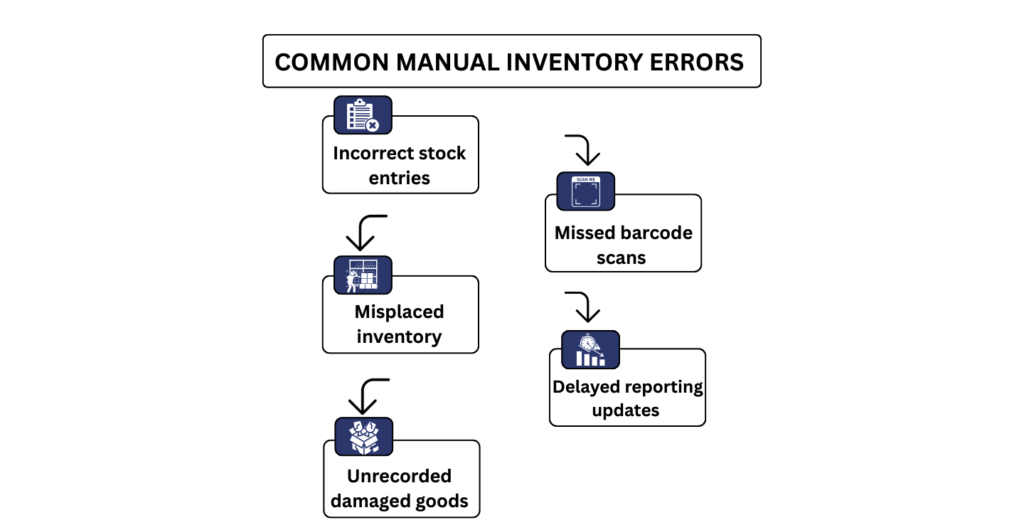
Common examples include:
- Incorrect stock entries
- Missed barcode scans
- Misplaced inventory
- Delayed reporting updates
- Unrecorded damaged products
When these issues happen repeatedly, inventory accuracy becomes weaker over time.
Forecasting Problems Usually Begin With Inaccurate Inventory Data
Reliable forecasting depends heavily on accurate inventory history.
When inventory records contain ongoing discrepancies:
- Purchasing becomes less accurate
- Seasonal demand gets misjudged
- Slow-moving products accumulate
- Stock shortages become more common
As a result, operational planning becomes reactive instead of strategic.
Even small inventory errors can distort business forecasting over several months.
Dead Stock Creates Hidden Financial Pressure
Dead stock rarely appears suddenly.
Instead, it builds gradually through:
- Poor inventory visibility
- Overstocking
- Weak forecasting
- Inaccurate purchasing decisions
Eventually, unsold inventory creates several financial problems.
Dead stock often causes:
- Higher storage costs
- Reduced liquidity
- Product obsolescence
- Inventory write-offs
- Lower profit margins
Many businesses continue purchasing products unnecessarily because inventory systems show inaccurate movement patterns.
Financial Consequences of Dead Stock
| Dead Stock Issue | Financial Consequence |
|---|---|
| Excess storage usage | Higher operational expenses |
| Unsold inventory | Reduced cash flow |
| Product obsolescence | Inventory write-offs |
| Poor stock rotation | Lower profitability |
How Businesses Can Reduce Inventory Financial Gaps
Improving inventory accuracy usually begins with better visibility and stronger operational consistency.
Businesses do not necessarily need perfect systems immediately.
However, they do need:
- Better processes
- Clear accountability
- Reliable inventory monitoring
Practical Ways to Improve Inventory Accuracy
1. Conduct Regular Inventory Audits
Frequent reviews help businesses detect discrepancies early.
Helpful practices include:
- Monthly cycle counts
- High-value inventory verification
- Reviewing recurring stock mismatches
2. Improve Inventory Accountability
Operational consistency reduces inventory confusion significantly.
Businesses should:
- Standardize inventory procedures
- Train employees regularly
- Reduce communication gaps between departments
3. Use Smarter Inventory Management Systems
Modern inventory platforms improve operational visibility and reduce manual work.
Helpful system improvements include:
- Real-time inventory monitoring
- Automated stock tracking
- Integrated financial reporting
- Workflow automation
Businesses working with Invoqat often improve inventory visibility by connecting operational workflows with centralized inventory management systems.
Why Inventory Visibility Matters More Than Many Businesses Realize
Inventory management quietly affects nearly every operational area inside a business.
When inventory becomes unreliable:
- Reporting slows down
- Customer service weakens
- Financial planning becomes less accurate
- Operational stress increases
However, when inventory visibility improves:
- Teams trust operational data more
- Purchasing decisions become smarter
- Customer fulfilment improves
- Financial reporting becomes more reliable
Even small operational improvements often create large long-term financial benefits.
Conclusion
Small inventory errors rarely appear dangerous at first. Yet over time, they gradually create larger financial gaps that affect profitability, operational efficiency, and customer trust.
A delayed stock update or incorrect product count may seem minor during a busy shift. However, repeated inconsistencies eventually weaken reporting accuracy, increase operational costs, and reduce customer confidence.
Businesses that prioritize inventory visibility early often avoid the long-term financial leakage caused by ongoing inventory inaccuracies.
Companies such as Invoqat continue helping organizations strengthen inventory management processes, improve operational visibility, and reduce preventable financial losses through smarter inventory control systems.
Ultimately, accurate inventory management is not simply an operational task. It is a critical part of building a financially stable and scalable business.
Frequently Asked Question
Small inventory errors accumulate over time, affecting financial reporting, purchasing decisions, cash flow, and customer satisfaction.
Inaccurate inventory creates overstocking, stock shortages, operational delays, and unreliable financial reporting, all of which reduce profitability.
Common causes include manual data entry mistakes, missed barcode scans, delayed updates, and poor inventory visibility.
Businesses can improve inventory accuracy through regular audits, better employee training, workflow standardization, and automated inventory systems.
Inventory visibility helps businesses make accurate purchasing decisions, improve customer fulfilment, reduce operational waste, and maintain reliable financial reporting.
