

Running out of stock rarely happens all at once. Instead, it starts quietly. A product sells faster than expected. A shipment arrives late. A customer walks away because the item is unavailable.
On the other hand, overstocking creates a different kind of pressure. Shelves look full, yet cash flow feels tight. Money sits in boxes instead of supporting growth.
For Companies in the UAE, where demand moves quickly and supply chains often span multiple countries, this balance becomes critical.
So how do some businesses consistently maintain the right stock levels while others struggle?
The answer often lies in one simple calculation: the reorder point formula.
When paired with smart systems like Invoqat Inventory from Invoqat, this formula becomes more than theory. It becomes a daily operational advantage.
Let’s break it down clearly and practically.
Why Inventory Mistakes Hurt More Than They Seem
Inventory errors rarely scream. They whisper.
- A customer asks for availability, and no one is certain.
- The warehouse says stock is “somewhere.”
- Emergency orders increase.
- Storage costs quietly rise.
Over time, small inaccuracies compound into serious financial strain.
In the UAE, additional pressures such as port delays, customs clearance, and seasonal demand spikes make inventory precision even more important.
That is why structured inventory planning supported by real-time tracking tools like Invoqat Inventory — reduces uncertainty significantly.
What Is the Reorder Point Formula?
The reorder point formula answers a simple but powerful question:
When should you place a new order to avoid running out of stock?
The formula is:
Reorder Point = (Average Daily Demand × Lead Time in Days) + Safety Stock
This formula consists of three core components:
- Average Daily Demand
- Lead Time
- Safety Stock
Each one matters. If even one number is inaccurate, your balance shifts.
Reorder Point Formula Components
| Component | Meaning | Why It Matters |
|---|---|---|
| Average Daily Demand | Units sold per day | Predicts depletion speed |
| Lead Time | Days until delivery | Prevents shortages |
| Safety Stock | Extra inventory | Covers unexpected delays |
| Reorder Point | Trigger level | Signals when to reorder |
Clarity here prevents confusion later.
Understanding Each Component
1. Average Daily Demand – The Consumption Rate
This represents how many units you sell per day, on average.
Instead of guessing, use historical sales data. Additionally, consider:
- Seasonal spikes (Ramadan, holidays, shopping festivals)
- Promotions
- Regional demand differences
For example, a Dubai-based retailer may see demand fluctuate during major events. Smart platforms like Invoqat Inventory automatically analyze trends, reducing dependency on rough estimates.
Small demand miscalculations can snowball quickly. Therefore, accuracy matters.
2. Lead Time – The Waiting Period
Lead time is the number of days between placing an order and receiving stock.
In theory, it is simple. In practice, it fluctuates.
Factors affecting UAE businesses include:
- Import delays
- Port congestion
- Supplier production issues
- Customs clearance timelines
Tracking actual lead time, not assumed lead time, is crucial. Invoqat Inventory logs supplier performance automatically, helping managers adjust reorder thresholds realistically.
3. Safety Stock – Your Protective Cushion
Safety stock acts as insurance against:
- Unexpected demand spikes
- Delivery delays
- Supplier inconsistencies
A common safety stock formula:
Safety Stock = (Maximum Daily Demand × Maximum Lead Time) − (Average Daily Demand × Average Lead Time)
Example Calculation:
- Average daily demand: 50 units
- Average lead time: 5 days
- Maximum daily demand: 70 units
- Maximum lead time: 7 days
Safety Stock = (70 × 7) − (50 × 5)
Safety Stock = 490 − 250
Safety Stock = 240 units
This buffer protects your operations from surprises.
Applying the Reorder Point Formula: Practical Example
Assume:
- Average daily demand = 40 units
- Lead time = 6 days
- Safety stock = 100 units
Reorder Point = (40 × 6) + 100
Reorder Point = 240 + 100
Reorder Point = 340 units
When inventory drops to 340 units, it’s time to reorder.
No guesswork. Just structure.
Reorder Point Example Summary
| Metric | Value |
|---|---|
| Average Daily Demand | 40 units |
| Lead Time | 6 days |
| Safety Stock | 100 units |
| Reorder Point | 340 units |
This clarity reduces panic decisions.
How the Reorder Point Prevents Stockouts
When applied consistently, the reorder point formula helps businesses:
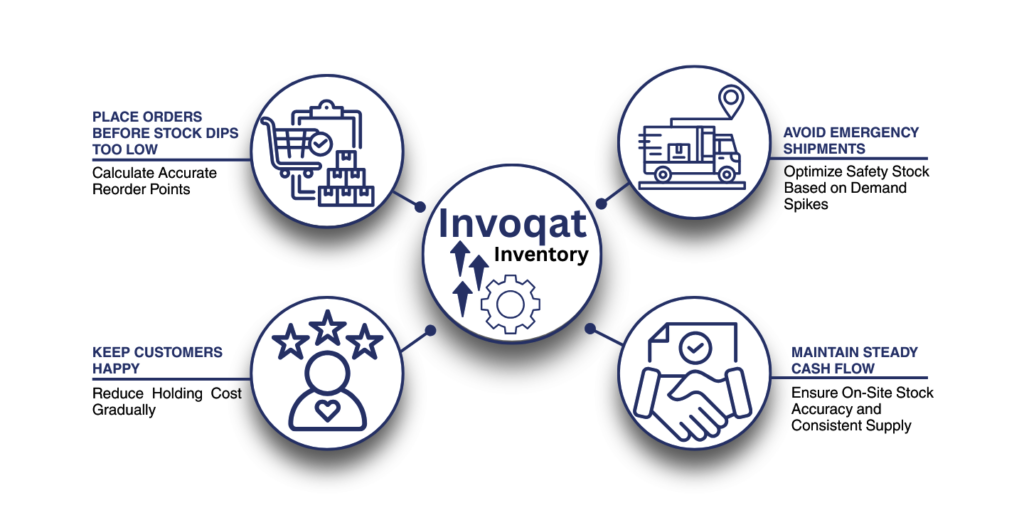
- Avoid emergency shipments
- Maintain steady sales flow
- Improve customer reliability
- Protect brand reputation
Recent global supply disruptions have shown that recalculating reorder thresholds early helps prevent revenue loss.
Preparation always costs less than reaction.
How It Prevents Overstock
Overstock silently ties up capital. It increases:
- Storage costs
- Insurance expenses
- Risk of obsolescence
The reorder point formula ties purchasing decisions directly to demand data. Consequently, orders are based on consumption rather than fear.
With Invoqat Inventory, alerts trigger automatically when stock hits predefined reorder levels, reducing emotional “just in case” purchases.
Inventory Planning as a Strategic Tool
Effective inventory planning connects multiple departments:
- Sales
- Procurement
- Finance
- Operations
When stock levels stay balanced:
- Cash flow becomes predictable
- Procurement becomes disciplined
- Customer satisfaction improves
For companies in the UAE managing multiple warehouses or outlets, centralized monitoring through systems like Invoqat Inventory provides a complete operational picture.
Impact of Using Reorder Point Formula
| Scenario | Without Formula | With Reorder Point |
|---|---|---|
| Ordering | Random | Structured |
| Stockouts | Frequent | Rare |
| Overstock | Common | Controlled |
| Cash Flow | Unstable | Predictable |
| Customer Satisfaction | Inconsistent | Steady |
The improvement becomes measurable over time.
Common Mistakes to Avoid
Even with formulas, errors happen. Watch for:
- Using outdated demand data
- Ignoring fluctuating lead times
- Skipping safety stock calculations
- Applying identical reorder rules to all SKUs
- Forgetting seasonal adjustments
Each product behaves differently. High-demand SKUs require closer monitoring.
Final Thoughts: Control Without Complexity
Inventory management does not need to feel unpredictable.
The reorder point formula offers structure. Safety stock provides resilience. Meanwhile, demand forecasting adds intelligence.
When combined with tools like Invoqat Inventory, businesses gain real-time monitoring and automated alerts that support smarter, calmer decisions.
For Companies in the UAE operating in high-volume, fast-paced markets, this structured approach reduces stress while protecting profitability.
In inventory management, balance is everything.
And balance begins with the right calculation.
Frequently Asked Questions
Ideally, review them quarterly. However, if demand is volatile or seasonal, monthly adjustments are recommended.
Yes. Supply chains are rarely perfectly stable. Safety stock prevents minor disruptions from becoming major losses.
Absolutely. Even companies with limited SKUs benefit from structured inventory planning.
Invoqat Inventory automates stock level tracking, monitors historical demand, logs supplier lead times, and sends real-time reorder alerts. This ensures businesses apply the formula consistently without manual monitoring.
Immediately recalculate both average demand and safety stock levels. Modern inventory systems make these adjustments easier and faster.
