
When Operations Feel Slightly Disconnected
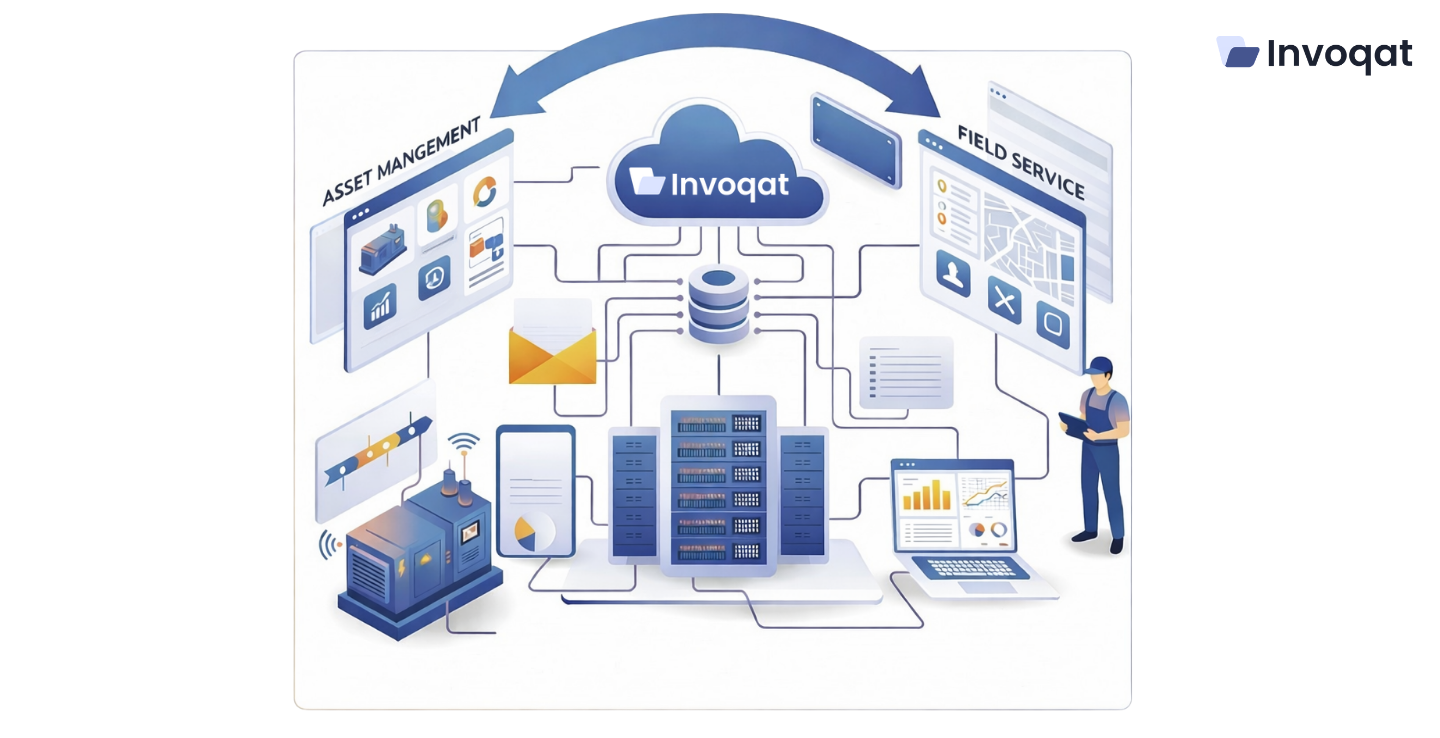
Service companies rely on two core functions to operate effectively: field service and asset management. On one side, field teams handle installations, repairs, and maintenance on-site. On the other, asset management focuses on tracking performance, maintenance history, and lifecycle value.
Individually, both functions perform well. However, when they operate separately, gaps begin to appear.
As a result, teams face delays, incomplete information, and operational inefficiencies.
This is exactly where integration becomes essential.
Organizations such as Invoqat are helping bridge this gap by connecting field operations with asset intelligence. Their approach improves visibility, reduces inefficiencies, and enables more structured service delivery.
Integrated vs Non-Integrated Systems
| Aspect | Non-Integrated Systems | Integrated Systems |
|---|---|---|
| Data Access | Distributed across systems | Centralized and real-time |
| Decision Making | Reactive and delayed | Proactive and data-driven |
| Technician Efficiency | Limited asset visibility | Full access to asset history |
| Customer Experience | Inconsistent updates | Reliable communication |
| Maintenance Approach | Reactive | Predictive and planned |
Understanding the Disconnect
At first glance, field service and asset management seem closely related. In practice, however, they often operate in silos.
Field service focuses on:
- Scheduling
- Dispatching
- Executing service tasks
Meanwhile, asset management handles:
- Performance monitoring
- Maintenance records
- Lifecycle tracking
Because these functions are separated, coordination becomes difficult.
For example:
- Technicians may lack access to full asset history
- Asset managers may not receive real-time updates
- Teams rely on manual communication
Over time, these gaps reduce efficiency and affect service quality.
The Operational Impact of Disconnected Systems
When systems remain disconnected, several challenges emerge.
- Workflows become inefficient
- Tasks are duplicated
- Service delivery slows down
- Errors increase
- Costs rise gradually
Additionally, teams spend more time searching for information instead of solving problems.
For instance, technicians might call support teams for asset details, while administrative staff reconcile data manually. These small delays accumulate and create noticeable operational friction.
Why Integration Changes Everything
Integration connects field service operations with asset data, creating a unified system.
As a result:
- Data becomes consistent across departments
- Updates happen in real time
- Manual processes are reduced
- Collaboration improves naturally
Instead of relying on multiple systems, organizations work from a single source of truth.
This shift enables faster and more confident decision-making.
Improving Technician Productivity
One of the most immediate benefits of integration appears in technician performance.
With access to complete asset and service history, technicians can:
- Diagnose issues faster
- Reduce repeat visits
- Complete tasks more efficiently
Moreover, better scheduling ensures the right technician is assigned to the right job.
Consequently, first-time fix rates improve, and service delays decrease.
Enhancing Customer Experience
Customer expectations continue to rise. Therefore, service quality must remain consistent and responsive.
Integrated systems support this by enabling:
- Faster response times
- Accurate communication
- Reliable service delivery
Customers receive clearer updates, while service teams operate with better coordination.
Ultimately, this builds trust and strengthens long-term relationships.
Enabling Predictive Maintenance
Another major advantage of integration is the ability to shift from reactive to predictive maintenance.
By analyzing asset data:
- Potential issues are identified early
- Maintenance is scheduled proactively
- Equipment failures are reduced
Over time, this approach:
- Extends asset lifespan
- Minimizes downtime
- Lowers maintenance costs
Impact of Integration on Key Metrics
| Metric | Before Integration | After Integration |
|---|---|---|
| First-Time Fix Rate | Moderate | High |
| Equipment Downtime | Frequent | Reduced |
| Service Response Time | Delayed | Faster |
| Customer Satisfaction | Variable | Consistent |
| Operational Costs | Higher | Controlled |
Choosing the Right Integration Strategy
Successful integration requires a structured approach.
Organizations should begin by:
- Assessing existing systems
- Identifying operational gaps
- Defining integration goals
Additionally, scalability and flexibility must be considered to support future growth.
Working with experienced providers like Invoqat ensures that implementation aligns with business needs.
Addressing Common Challenges
Although integration offers clear benefits, some challenges may arise.
- Resistance to change
- Data migration complexity
- Initial investment concerns
- Training and adoption issues
However, these challenges can be managed effectively through:
- Phased implementation
- Proper training programs
- Clear communication
Challenges and Solutions
| Challenge | Recommended Approach |
|---|---|
| Resistance to change | Provide training and support |
| Data silos | Implement centralized integration |
| High initial cost | Use phased deployment |
| Limited expertise | Work with experienced partners |
The Future of Service Operations
Looking ahead, service companies are increasingly adopting integrated systems.
Several trends support this shift:
- Greater reliance on real-time data
- Increased use of analytics
- Rising customer expectations
- Demand for operational transparency
Integration is no longer optional it is becoming a competitive advantage.
Final Thoughts
When field service and asset management operate independently, inefficiencies quietly build over time. However, once these functions are integrated, operations become more aligned and efficient.
Organizations that adopt this approach benefit from:
- Better visibility
- Improved productivity
- Stronger customer satisfaction
Companies like Invoqat demonstrate how structured integration can transform service environments into coordinated, data-driven ecosystems.
In the end, integration is not just a technical upgrade. It is a strategic decision that supports long-term growth, operational clarity, and consistent service excellence.
Frequently Asked Questions
Because it connects field operations with asset data, improving efficiency and decision-making.
It provides access to complete asset history, enabling faster and more accurate service.
Yes. By minimizing manual work and improving efficiency, costs decrease over time.
It uses data to identify potential issues before failures occur, reducing downtime.
Absolutely. Even smaller teams gain better coordination and improved service delivery.
