
Introduction: When Delays Quietly Disrupt Everything
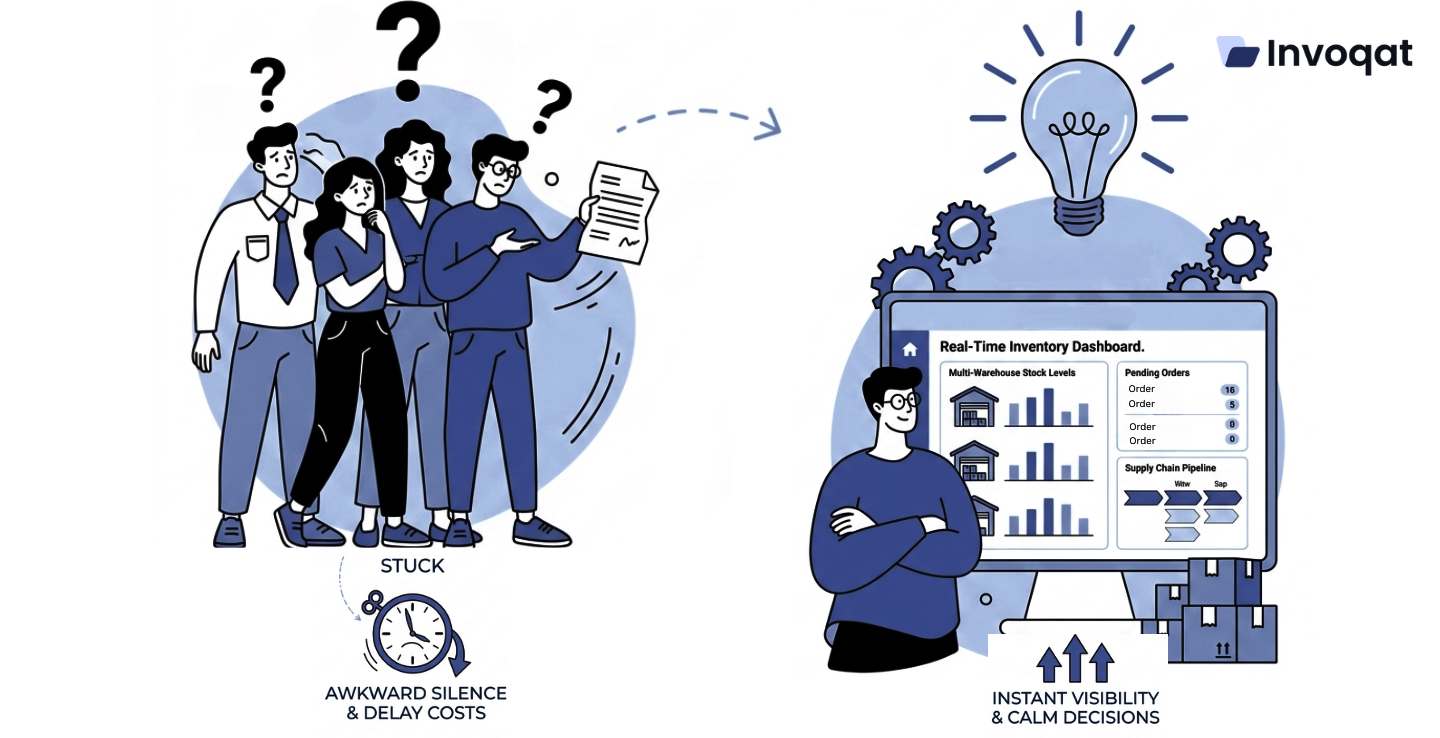
You have probably experienced this situation before. A shipment gets delayed, customers are waiting, and someone asks the same question again:
At first, the silence feels awkward. However, it quickly becomes clear that the issue is not just communication it is cost.
Inventory delays rarely appear suddenly. Instead, they build gradually through missed updates, outdated reports, and fragmented systems. As a result, customer trust weakens, operations slow down, and revenue begins to slip.
This is exactly where real-time inventory dashboards prove their value. Rather than acting as a luxury feature, they become an operational necessity for modern businesses.
Now consider a different scenario.
Instead of searching through spreadsheets, you open a dashboard and instantly see stock levels, pending orders, and potential bottlenecks. More importantly, everything updates in real time. Consequently, decisions become faster, more accurate, and noticeably calmer.
In many cases, this shift is not only technological. It also transforms how teams think and act. Rather than reacting to problems, teams begin anticipating them and that changes everything.
Traditional vs Real-Time Inventory Systems
| Aspect | Traditional Systems | Real-Time Dashboards |
|---|---|---|
| Data Updates | Periodic, delayed | Instant and continuous |
| Decision Making | Reactive | Proactive |
| Error Rate | Higher (manual input) | Lower (automation) |
| Visibility | Fragmented | Centralized |
| Response to Delays | Slow | Fast and informed |
How Real-Time Dashboards Reduce Delays
Instant Visibility Across Operations
When data updates continuously, every team works with the same information at the same time. For example, a warehouse manager and a sales executive can both view identical stock levels instantly.
As a result, confusion decreases and alignment improves. In addition, teams no longer need to wait for reports or verify numbers manually.
Faster Decision Making
Speed plays a critical role in inventory management. When a product begins running low, real-time dashboards highlight the issue immediately.
Therefore, teams can respond quickly by:
- Reordering stock
- Redistributing inventory
- Adjusting customer commitments
Instead of reacting late, businesses act early and that prevents delays.
Early Detection of Bottlenecks
In most cases, delays do not happen overnight. Rather, they begin as small disruptions.
For instance:
- A supplier runs behind schedule
- A warehouse faces increased order volume
- A shipment slows down unexpectedly
Meanwhile, real-time dashboards capture these early signals. Consequently, teams can resolve issues before they escalate into major delays.
Improved Coordination Between Teams
When departments rely on shared data, communication becomes far more efficient.
Previously, teams might exchange multiple emails or calls to confirm details. Now, however, everyone sees the same information instantly.
As a result:
- Misunderstandings decrease
- Collaboration improves
- Decision-making becomes faster
Key Features That Make Dashboards Effective
Not all dashboards deliver meaningful results. However, the most effective ones include:
- Live data synchronization across systems
- Custom alerts for stock shortages or delays
- Visual dashboards showing trends and patterns
- Integration with ERP and supply chain systems
- Simple interfaces for non-technical users
In short, the goal is not just to display data but to make it useful.
Cost Impact of Inventory Delays
| Delay Type | Business Impact | Cost Effect |
|---|---|---|
| Stock-outs | Lost sales | High |
| Overstocking | Holding costs | Medium |
| Late deliveries | Customer dissatisfaction | High |
| Manual errors | Rework required | Medium |
| Poor forecasting | Inefficient purchasing | High |
Integration with Broader Business Systems
Real-time dashboards become even more powerful when connected with other platforms.
For example:
- ERP systems provide financial insights
- CRM systems reveal customer demand patterns
- Supply chain tools track logistics performance
As these systems integrate, data begins to flow seamlessly across departments. Consequently, businesses gain a unified view of operations rather than isolated snapshots.
Challenges in Implementation
Although the benefits are clear, implementation may present challenges.
For instance:
- Some teams resist change
- Data inconsistencies may appear initially
- Training requires time and effort
However, these challenges are temporary. Over time, the operational advantages outweigh the initial effort.
Best Practices for Successful Implementation
To achieve the best results, businesses should follow a structured approach:
- Start with clear objectives
- Ensure data accuracy before integration
- Train teams thoroughly
- Choose scalable solutions
- Continuously refine processes
By doing so, organizations can maximize long-term value.
Industry Applications of Real-Time Dashboards
| Industry | Use Case | Benefit |
|---|---|---|
| Retail | Store-level stock tracking | Reduced stock-outs |
| Manufacturing | Raw material monitoring | Better production flow |
| Healthcare | Medical inventory tracking | Critical availability |
| Logistics | Shipment tracking | Faster deliveries |
| E-commerce | Order fulfillment | Improved customer experience |
Final Thoughts
Ultimately, real-time inventory dashboards do more than improve efficiency. They create an environment where decisions are informed, actions are timely, and teams remain aligned.
Without real-time visibility, businesses rely on fragmented data and delayed reports. On the other hand, with real-time dashboards, organizations gain clarity and control.
Over time, this shift influences every department. Teams collaborate more effectively, managers make confident decisions, and operations run more smoothly.
In the end, delays rarely disappear on their own. Instead, they must be identified, understood, and addressed early.
Real-time dashboards make that possible.
And perhaps most importantly, they replace uncertainty with confidence something every growing business needs.
Frequently Asked Questions
A real-time inventory dashboard is a digital tool that displays live inventory data, including stock levels, order status, and movement across locations. Unlike traditional systems, it updates continuously, allowing teams to make decisions based on current information rather than outdated reports.
Real-time dashboards reduce delays by providing instant visibility into inventory and operations. As a result, teams can quickly identify stock shortages, shipment issues, or bottlenecks and take immediate action instead of reacting too late.
Yes, small businesses can benefit significantly. In fact, real-time dashboards help smaller teams operate more efficiently by reducing manual work, improving accuracy, and enabling faster decision-making without needing large operational resources.
Absolutely. When businesses have accurate, up-to-date inventory information, they can provide reliable delivery timelines, avoid stockouts, and respond to customer inquiries more confidently. Consequently, customer trust and satisfaction improve.
Platforms like Invoqat provide integrated inventory systems with real-time dashboards, helping businesses track stock, monitor supply chains, and gain actionable insights. In addition, they enable teams to respond quickly to changes and maintain operational control.
