
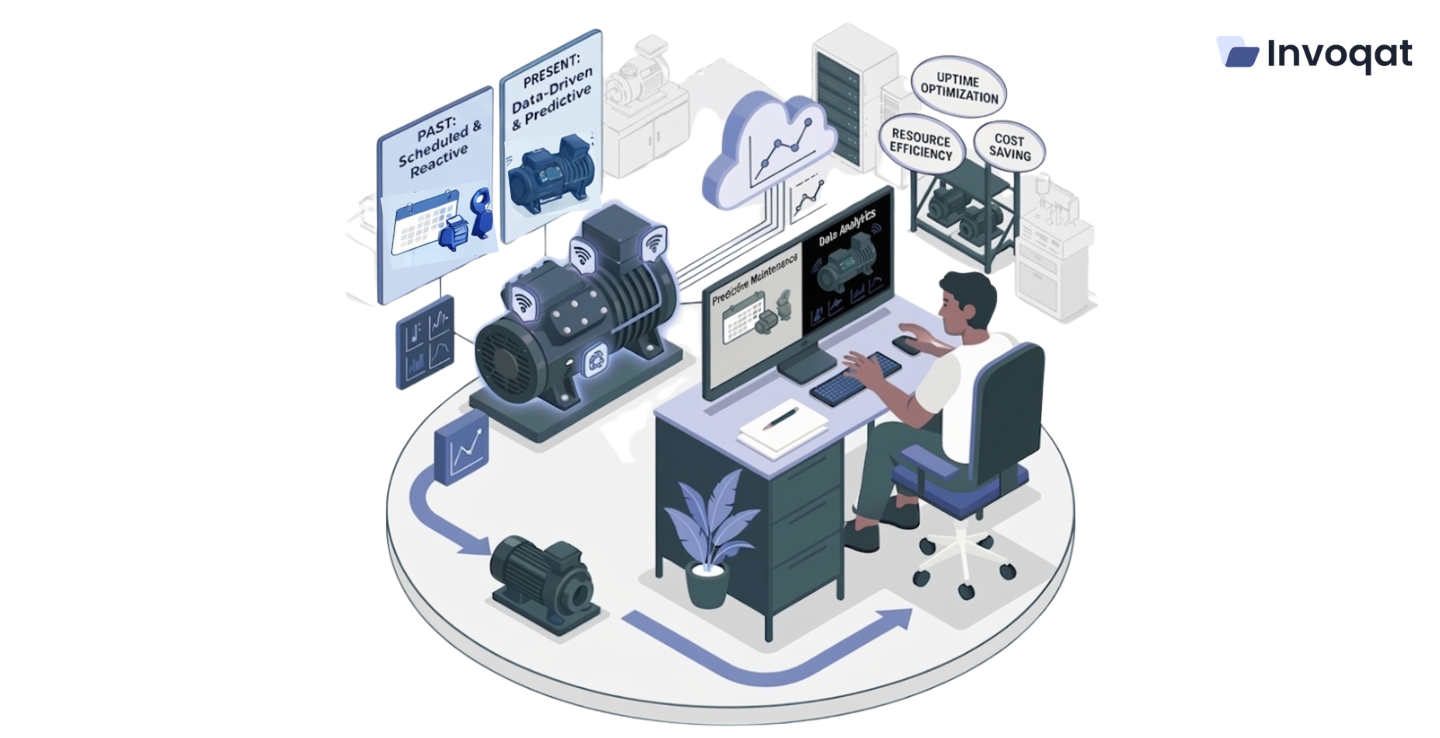
From Reactive Fixes to Smart Maintenance
IoT-connected assets are transforming how field service maintenance operates. Traditionally, teams relied on reactive repairs or fixed schedules. However, IoT-connected assets provide real-time visibility, enabling organizations to monitor performance, predict failures, and improve maintenance efficiency.
However, as operational demands continue to grow, organizations are shifting toward smarter, data-driven strategies.
This is where IoT-connected assets begin to play a transformative role.
Instead of waiting for problems to occur, businesses can now monitor assets in real time, predict failures before they happen, and manage resources more effectively.
Solutions offered by companies like Invoqat are helping organizations adopt this approach by combining connectivity, analytics, and automation into everyday field service operations.
Maintenance Approaches Comparison
| Aspect | Reactive Maintenance | Predictive Maintenance |
|---|---|---|
| Approach | After failure | Before failure |
| Downtime | High | Low |
| Cost | Unpredictable | Controlled |
| Efficiency | Limited | Optimized |
What Are IoT-Connected Assets?
IoT-connected assets improve maintenance. As a result, teams gain real-time data. Therefore, they can respond faster.
These assets can include:
- Machinery
- Vehicles
- Medical equipment
- Infrastructure systems
Key Characteristics:
- Continuous data collection
- Remote monitoring capabilities
- Automated alerts and notifications
- Integration with centralized platforms
As a result, organizations gain visibility into asset performance without relying solely on manual inspections.
Why Field Service Needs Modernization
Traditional field service models face several ongoing challenges:
- Limited visibility into asset condition
- Delayed response to failures
- Inefficient scheduling
- High operational costs
Consequently, these limitations reduce efficiency and increase downtime.
By contrast, IoT introduces transparency, automation, and real-time decision-making addressing these challenges directly.
Key Benefits of IoT-Connected Assets
Predictive Maintenance
Rather than reacting to breakdowns, predictive maintenance uses data to anticipate failures.
By analyzing patterns such as vibration, temperature, or usage trends:
- Issues are detected early
- Maintenance is scheduled proactively
- Unexpected downtime is reduced
Real-Time Asset Monitoring
Real-time monitoring provides continuous insight into asset performance.
This enables:
- Immediate detection of anomalies
- Faster decision-making
- Improved operational visibility
As a result, both technicians and managers can respond more effectively.
Efficient Resource Utilization
IoT systems improve how resources are allocated.
For example:
- Technicians are assigned based on real needs
- Spare parts are prepared in advance
- Travel and labor costs are minimized
Over time, this leads to higher productivity and cost efficiency.
Industry Applications Overview
| Industry | Application | Outcome |
|---|---|---|
| Manufacturing | Equipment monitoring | Increased uptime |
| Healthcare | Device tracking | Improved safety |
| Utilities | Smart infrastructure | Enhanced efficiency |
Technologies Powering IoT Systems
IoT performance depends on multiple technologies working together.
Sensors and Data Collection
- Capture real-time asset data
- Monitor parameters like temperature, pressure, and vibration
Connectivity Networks
- Enable communication via Wi-Fi, cellular, or low-power networks
- Support real-time monitoring across locations
Cloud Computing
- Store and manage large volumes of data
- Provide remote access and scalability
Data Analytics and AI
- Convert raw data into actionable insights
- Identify patterns and predict failures
Edge Computing
- Process data closer to the source
- Enable faster responses in critical situations
Integration Platforms
- Connect IoT systems with ERP and maintenance tools
- Automate workflows and reduce manual tasks
Security Technologies
- Protect systems with encryption and access control
- Ensure safe and reliable operations
Implementation Challenges
While IoT offers clear advantages, organizations must address certain challenges.
Security Risks
Increased connectivity can introduce vulnerabilities. Therefore, strong security measures are essential.
Integration Complexity
Connecting IoT systems with existing infrastructure can be difficult, especially when legacy systems are involved.
Implementation Challenges
| Challenge | Impact | Mitigation Strategy |
|---|---|---|
| Security Risks | Data vulnerability | Implement encryption and access controls |
| Integration Issues | Operational delays | Use scalable and compatible platforms |
| Initial Costs | Budget constraints | Adopt phased implementation |
The Role of Invoqat in IoT-Driven Maintenance
Organizations adopting IoT often require structured guidance.
Invoqat supports this transition by:
- Enabling real-time asset visibility
- Streamlining maintenance workflows
- Integrating IoT with existing systems
Their approach focuses on practical implementation rather than unnecessary complexity.
Final Thoughts: A Shift Toward Smarter Maintenance
IoT-connected assets are reshaping field service maintenance in meaningful ways.
Instead of relying on assumptions or delayed reports, organizations now operate with:
- Real-time insights
- Predictive capabilities
- Better coordination
Although the transition requires planning, the long-term benefits are clear greater efficiency, lower costs, and improved service reliability.
As businesses continue investing in IoT, the focus will remain on making operations smarter, faster, and more responsive.
Frequently Asked Questions
They are physical assets equipped with sensors that collect and transmit real-time data.
It enables predictive maintenance, real-time monitoring, and better resource planning.
Manufacturing, healthcare, utilities, and logistics see significant improvements.
Initial costs can be high, but phased adoption helps manage investment effectively.
Yes, with the right integration platforms and APIs, IoT systems can connect with ERP and maintenance tools.
